- Contact us
- +7 (812) 425-24-57

 ▼

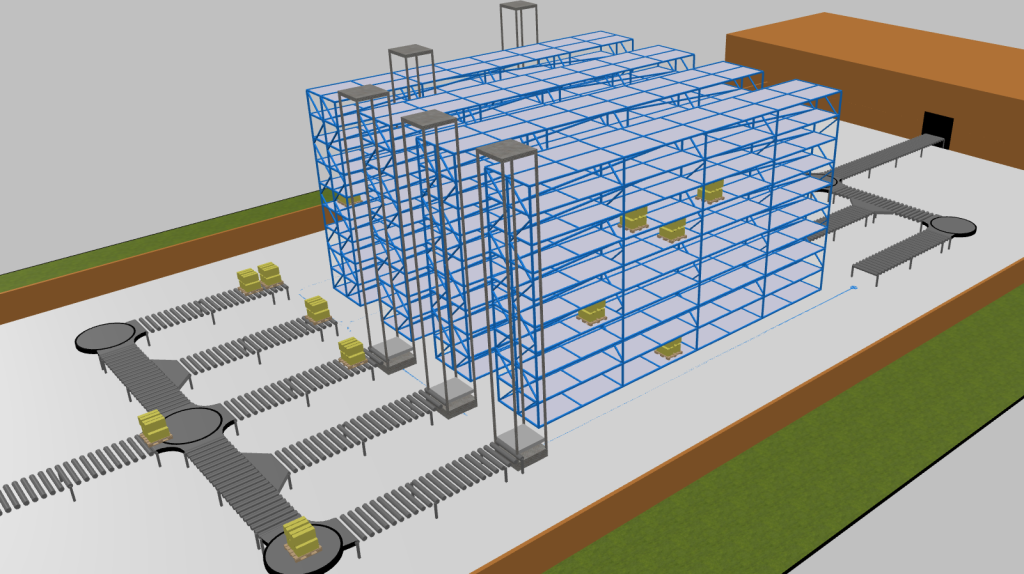
Simulation Modeling for Robotization of Warehouse Complexes
Interest in robotization at distribution centers is driven by several important factors. First of all, many regions face an acute shortage of qualified personnel for warehouse work, caused by the physically demanding nature of the labor, high staff turnover, and demographic changes. In addition, manual labor carries the risk of errors and injuries, which reduces the overall efficiency of warehouse operations.
The introduction of robotization makes it possible to significantly increase productivity and accuracy of operations, reduce routine and heavy tasks for employees, and also lower the costs of logistics operations and safety. Companies gain the ability not only to compensate for the shortage of manpower, but also to make processes more sustainable and predictable, improving the quality of customer service and competitiveness.
Robotization and Modeling
The main goal of introducing robots at distribution centers is the optimization of logistics processes. Robots are intended to automate the operations of moving, sorting, and packaging goods, minimizing human involvement wherever possible. The robotic scenario shows a reduction in order processing time by an average of 20–30%, a decrease in the number of employees, and a reduction in the number of errors to an almost zero level. At the same time, the question arises of choosing equipment types, their quantity, and the specific configuration.
Simulation modeling is used to evaluate the performance of various equipment configurations, accurately calculate the required staffing, buffer zone sizes, and optimize robot and cargo movement routes. This methodology makes it possible to predict bottlenecks at the design stage and determine optimal parameters to achieve maximum efficiency and reduce order processing time.
Experiments in the Model
During the experiments, two scenarios are compared: a distribution center without robotization and a warehouse in which robots have been introduced. Performance parameters, operation durations, equipment travel distances, and personnel workload are studied. At the same time, during the modeling process, buffer sizes, the number of robots, and routes are calibrated to avoid bottlenecks and downtime.
Thus, the simulation model (SM) receives as input data on the warehouse topology (usually in DXF or DWG formats), a description of warehouse processes in the form of corresponding diagrams, personnel data, and extracts from the warehouse management system on receiving, shipping, picking, and internal movements. With this data, an "as is" model of the existing distribution center is created. By conducting computational experiments with this model, we obtain statistics on the operation of the distribution center and reports on each operation. The results of such modeling make it possible to verify the correctness of the model itself and the input data by comparing the operation log obtained from the model with the actual one. Based on the experience of real projects, 95% is an achievable simulation accuracy figure.
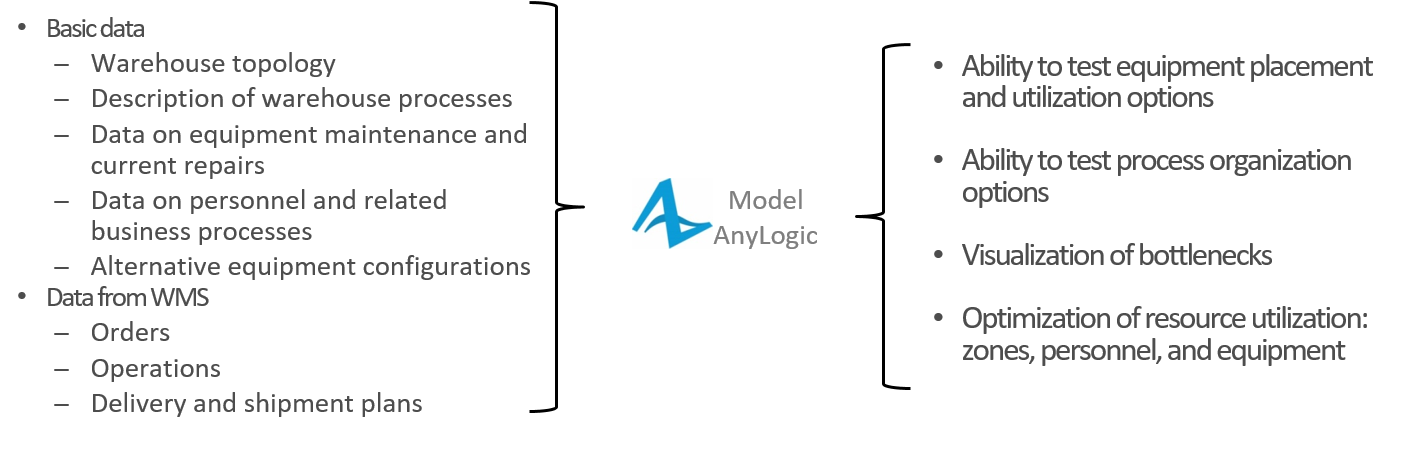
Next begins the construction of a series of modified models with alternative equipment configurations, automation, robot introduction, changes in business processes, algorithms for selecting storage locations for product groups, and product picking routes. The purpose of experiments with modified models is to provide a detailed answer to the questions: "what if?", "how could it be?", and "wouldn't it be better?".
Modern Warehouse Robots
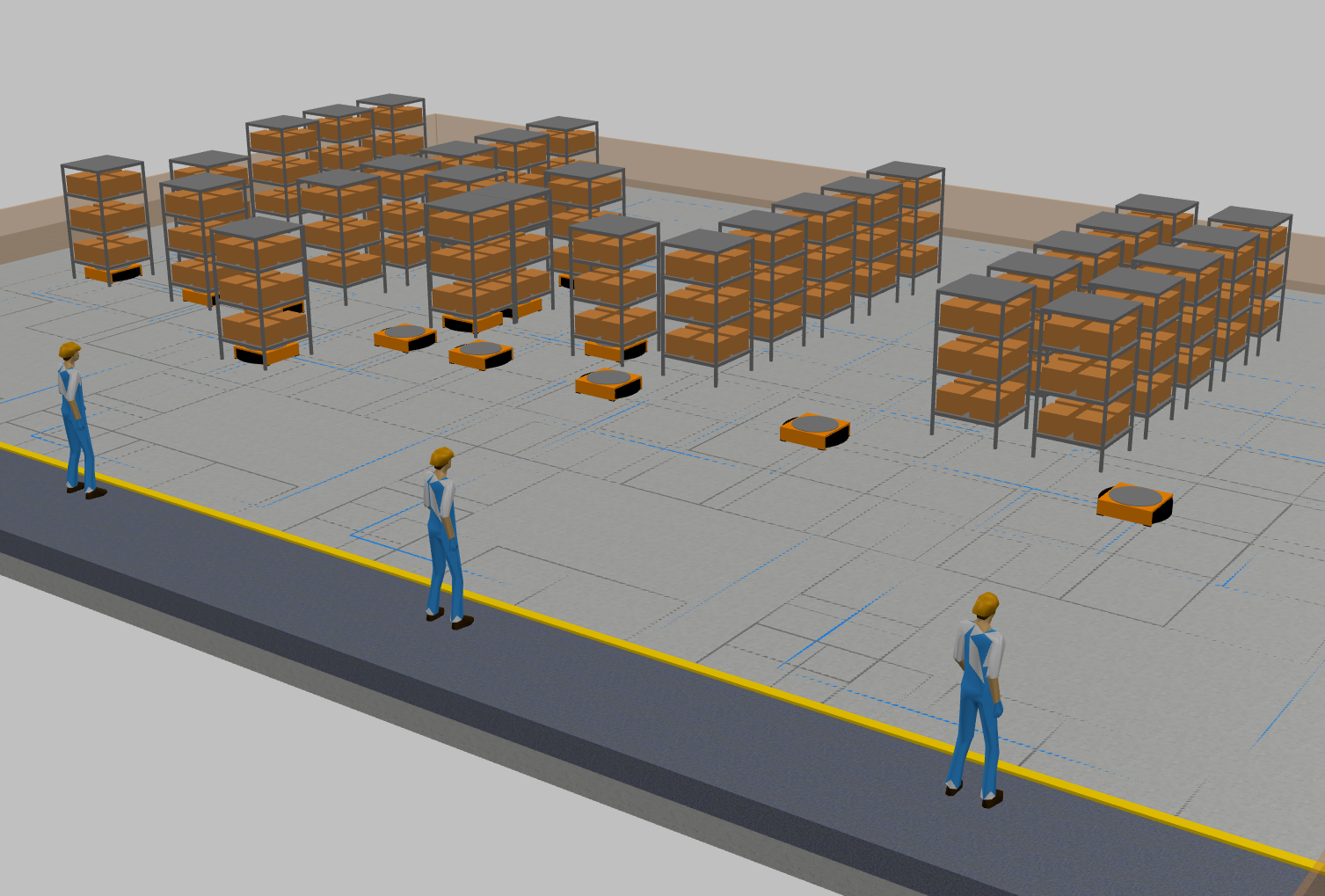
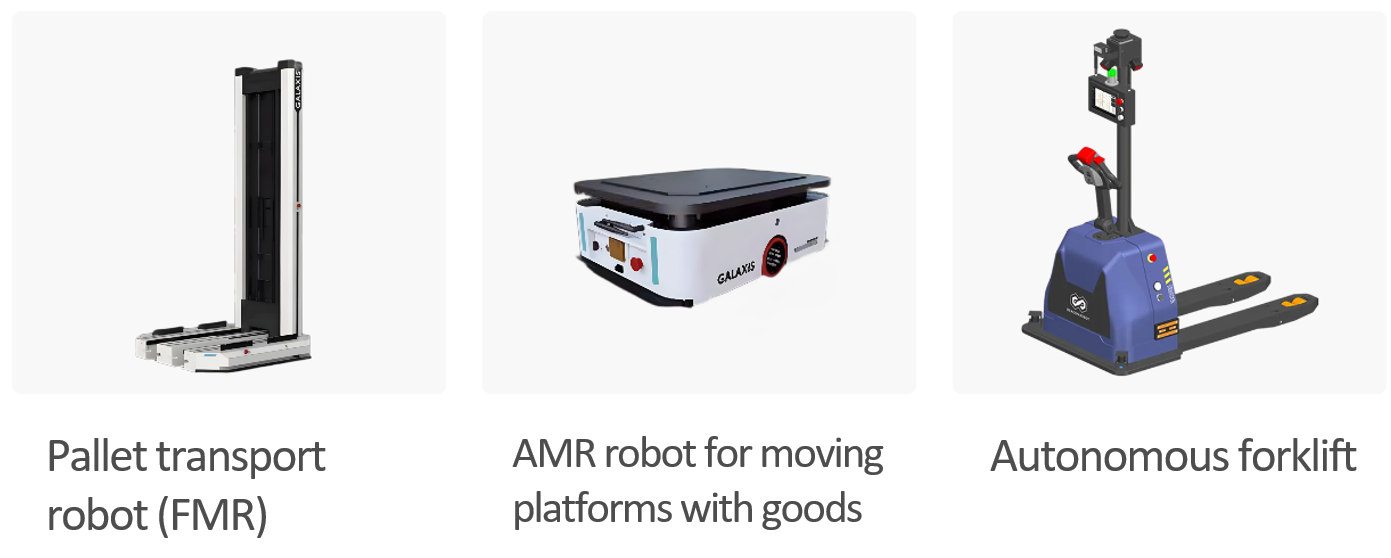
In 2025, mobile robotic devices (AMR – Autonomous Mobile Robots) are beginning to be used en masse in warehouses; they are used to move goods around the warehouse, efficiently performing routing and avoiding obstacles.
For more precise handling, robotic manipulators are used, which assist in retrieving and sorting goods. RFID and barcode systems integrated with robotic devices are actively used for automatic registration and accounting.
|
|
The introduction of robotic systems such as automated storage and retrieval systems (ASRS) makes it possible to efficiently organize the process of storing goods, reducing the time for retrieval and placement. Robots automatically transport goods to the required shelf or zone, and also retrieve them on request.
In addition to this, warehouse management systems (WMS) are integrated with robotic solutions to track the location of goods in real time.
Modern warehouses are permeated with conveyor networks, which are actively used together with robots and automated storage systems. Such conveyors may include stations with manual or, again, robotic processing of goods.
As a result of the introduction of such solutions, the time for searching and retrieving goods is reduced by 20–30%, which increases the overall efficiency of the warehouse and reduces operating costs.
Discrete-Event Simulation in AnyLogic
Warehouse system models map well onto the apparatus of discrete-event simulation. The developers of AnyLogic software have been actively introducing support for modern tools for modeling warehouse and industrial robotization systems over the past 7 years. To verify this, it is enough to look at the list of corresponding changes on the vendor's website:
- 2018 – The main innovation of AnyLogic 8.3 – a specialized Library of Production and Logistics Systems.
- 2019 – AnyLogic 8.4. Now conveyors – robotic carts (AGV, AMR, FMR, etc.) – can move without being tied to space markings and take into account obstacles in their path, including walls, conveyors, and other transporters.
- 2019 – AnyLogic 8.5. A density map was added for transporters that move in the model without being tied to space markings. The new "Crane" element allows objects to be moved between conveyor networks even if they are not connected, and the "Conveyor Branch" element allows conveyors to be connected more flexibly at an angle. It has become easier to model multi-level objects – buildings, conveyors – within a single object.
- 2020 – AnyLogic 8.6. The ability was added to limit the speed of transporters or prohibit them from moving in certain areas of the model. After a task is released or canceled, the transporter can independently choose the nearest base and head to it or to a user-specified location.
- 2021 – AnyLogic 8.7. The new "Warehouse" element makes it easier to model storage premises. Two types of racks are supported: selective and drive-in.
- 2022 – AnyLogic 8.8. The ability to change the direction of a conveyor appeared. The process of specifying buffers on a conveyor has been simplified, as well as conveyor networks with reversible conveyors that lead to workstations on both sides of the main line. In the new version, the "Warehouse" marking element began to support FIFO and LIFO rack types, as a result of which it became possible to model selective, drive-in, gravity, and push-back racks. In addition, the ability to change the location of aisles for loading/unloading them was added. For the "Processing Station" element, a task prioritization mechanism was added. Transporters in free-navigation mode now disperse more efficiently in corridors and resolve deadlock situations. The improvements primarily affected the modeling of warehouse premises where transporters move along narrow aisles between racks.
- 2023 – AnyLogic 8.8.4. Introduction of genetic optimization algorithms, actively used in optimizing the number of personnel and equipment at warehouses and production facilities.
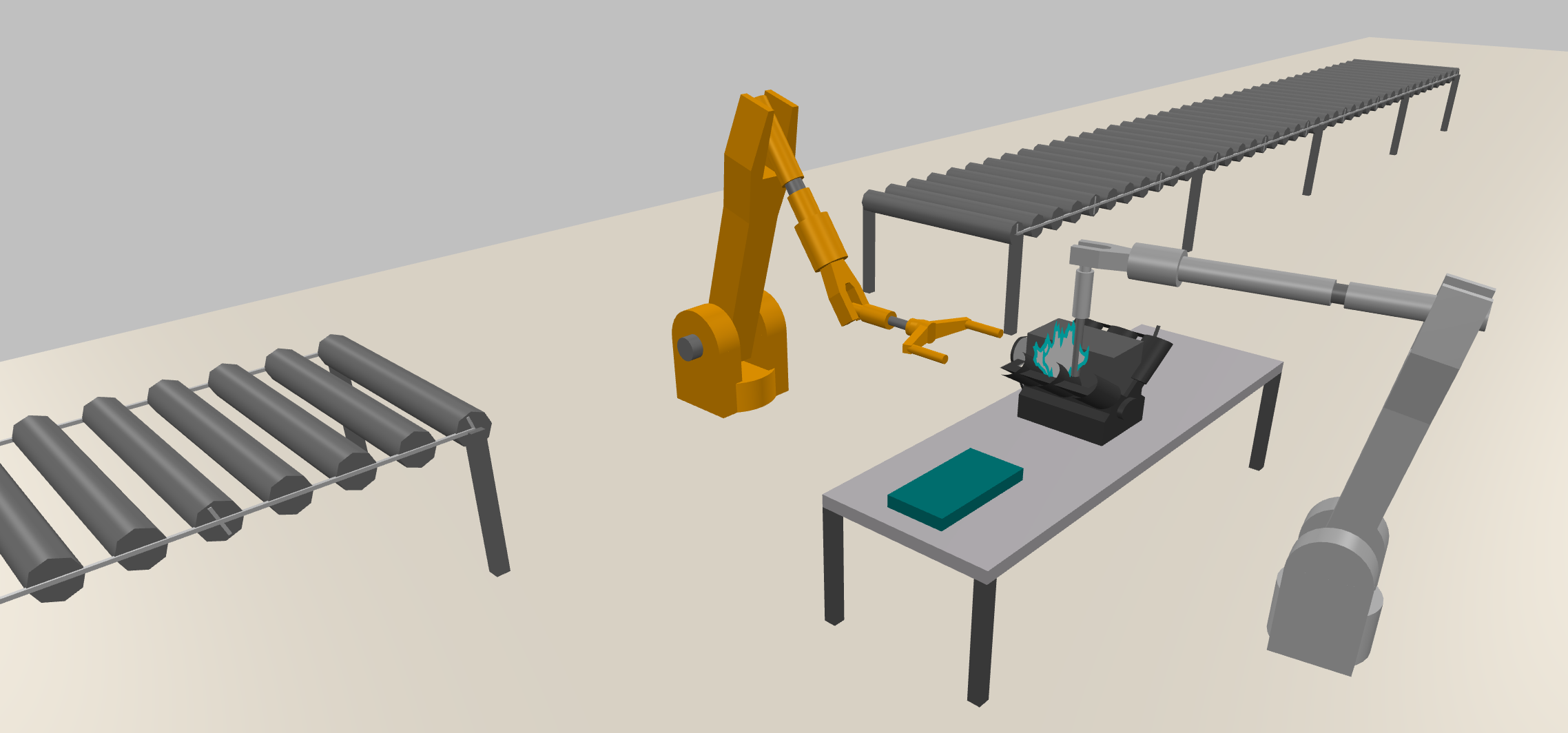
- 2024 – AnyLogic 8.9. Software control of conveyors was added. In AnyLogic 8.9.2, a new 6-axis robotic arm appeared, which significantly increases the realism and expands the capabilities of industrial modeling, supporting tasks such as pallet assembly, welding, and painting.
- 2025 – AnyLogic 8.9.4-8.9.5. Realistic specification of charging and failures of robotic transporters. The new SeizeRobot and ReleaseRobot blocks support multi-stage workflows. Moreover, robots can now follow precise trajectories and switch tools, such as welding guns or vacuum grippers, during processing.
Example of a Warehouse Modeling Project
Let us consider a specific project on modeling distribution centers, carried out in full accordance with the approach described above: for each warehouse, an "as is" model was first developed, and then "what if?" scenarios.
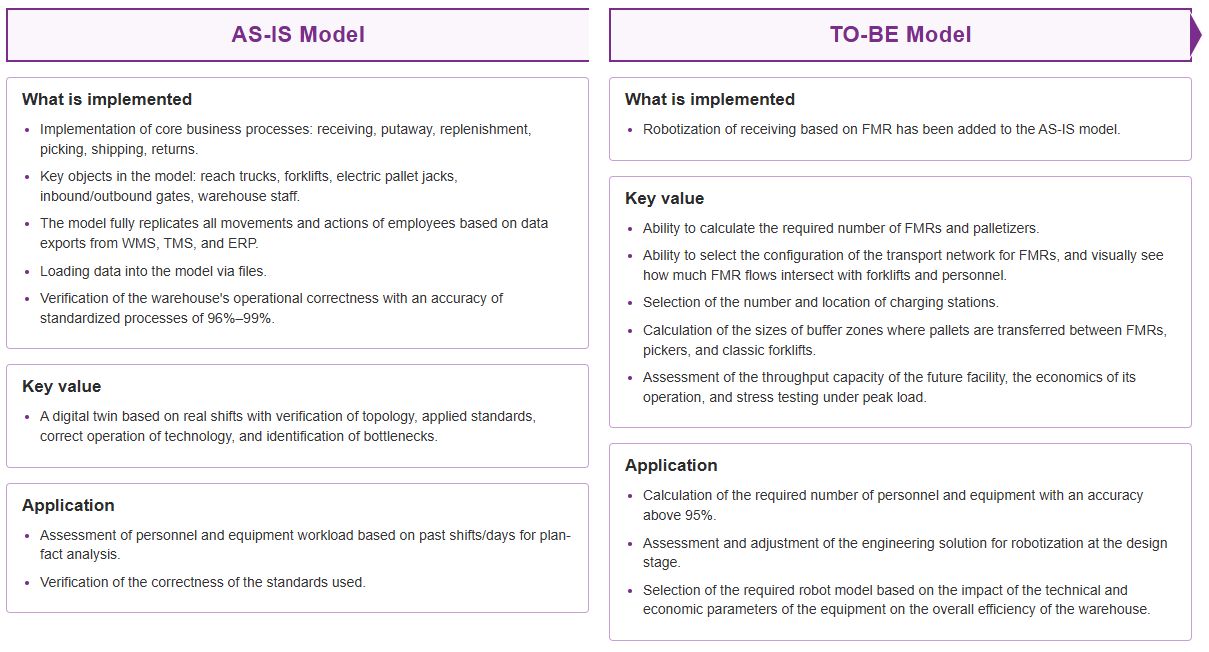
More detailed information about the project is available in the corresponding case study — a description of the project on modeling warehouse robotization scenarios for a large Russian retailer.
Results
The introduction of "conscious" robotization, calculated using simulation modeling, at distribution centers makes it possible to achieve a significant economic effect: a reduction in operating costs of up to 40%, a decrease in personnel requirements while simultaneously increasing order processing volumes.
In addition, such projects contribute to the fulfillment of corporate development and digital transformation strategies, allowing businesses to remain competitive against the backdrop of e-commerce market growth and the increasing complexity of logistics operations.
Simulation modeling has proven its good applicability as a tool for evaluating proposed technological solutions for robotization and is now becoming an important part of comprehensive automation projects.
The created simulation models are being integrated into the operational work of the warehouse; being combined with the warehouse's IT systems (WMS, TMS, RMS, ERP), they represent full-fledged digital twins, allowing various strategies for product placement and picking to be tested and even optimized.