


Background
In 2018, a business customer commissioned a development strategy from one of the Big Four leaders. As an example, the consultants created a demo model of material and technical resource (MTR) supply to a mine in Eastern Siberia, which greatly interested the management. Based on the presented solution, a working group was established in the customer's logistics department, and they decided to evaluate complex logistics challenges using simulation modeling. It was decided to consider building a supply chain to one of the customer's new mines as a pilot project.
Problem statement
During the project implementation, we realized that the customer had underestimated the capabilities of modeling. While refining the technical specifications, we expanded the scope to obtain a simulation model that would deliver value and achieve the customer's goals. To implement the project, the customer additionally engaged the resources of the management company and expanded the working group with employees from the commercial department.
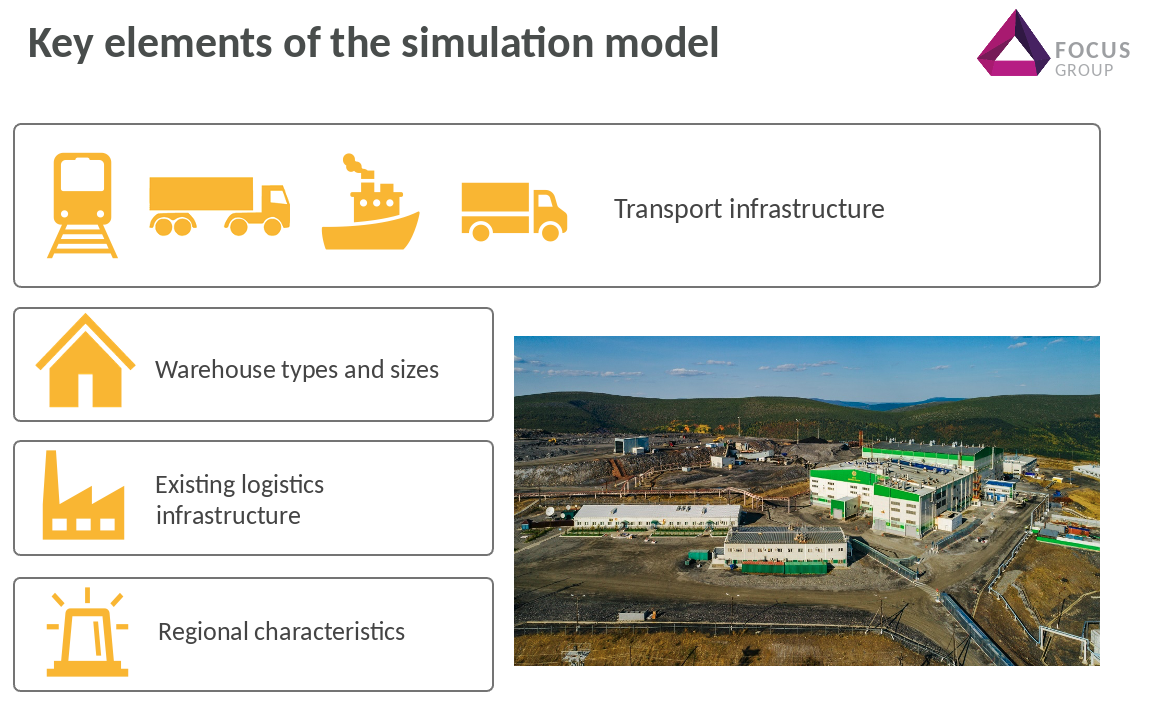
Project implementation
The first model was presented within a short timeframe to demonstrate the routes and movement across the entire supply chain. The analysis showed that the data provided by the design organizations was insufficient. In particular, they had noted the presence of warehouse infrastructure in 2019, whereas by mid-year only exploration mining had been carried out there.
Specialists from the working group used analytical tools to calculate the potential economic effect of the project implementation but could not account for all physical constraints related to logistics pauses, vehicle load volumes per trip, and average and maximum storage volumes at warehouses, considering the uneven arrival of goods by rail. The supply chain initially involved sending a significant volume of construction materials to build a transshipment area, permanent accommodation facilities for personnel, and a mining and processing plant at the deposit. Using simulation modeling, we were able to account for all the specifics of this supply chain and present the working group with calculations comparable in accuracy to real cargo movement.
Concept change
To assess the sufficiency of components for associated works and mining, foreign consultants were engaged. They provided up-to-date calculations on the number of nomenclature items and volumes of materials required for the mining process and the creation of the mine's infrastructure. The cargo volume increased by several orders of magnitude, which led to a revision of the entire supply chain. Additionally, they proposed calculating a direct route without creating transshipment areas. Using modeling, we obtained calculations for all the presented routes and also added extended routes using public bypass roads.
In the preliminary model calculations, we focused on the options proposed by the working group. After the foreign consultants joined, the number of routes increased severalfold. The working group recognized the need to expand the task and model all options. Additionally, we included new routes in the supply chains for elaboration and presented the modeling results for discussion in the working group.
New changes and savings as a result
As a result of the modeling, two competing supply chains were selected, differing in capital expenditures by a significant amount. Several representatives of the working group presented their arguments in favor of the more expensive option, citing its lower capital expenditures. As a result, at the first project defense, a supply chain with lower capital expenditures and higher cargo delivery costs to the deposit was approved.
For the final stage of the project defense, heads of other customer projects were invited to popularize the technology and exchange opinions about the project. As a result of the discussion, it was proposed to update the equipment purchase costs in line with completed procurements and to update cargo delivery tariffs along the routes due to the working group's underestimated cost assessment.
As a result of the tariff update by the working group, based on the modeling results, we obtained tangible benefits from the direct route without transshipment areas, which enabled a cost reduction of several billion rubles over the modeled construction horizon and the first 10 years of deposit operation. The cost reduction achieved through simulation modeling allowed the customer to identify the most profitable route and obtain accurate estimates of alternative cargo delivery options.