


The client is a large European food manufacturer. The distribution center handles the full warehouse cycle: receiving products, putting them away for storage, order picking, and shipping to retail chains. The warehouse operates in shift mode with a broad assortment of products with limited shelf life, so errors in planning personnel or equipment are costly: a failed truck assembly delays delivery of perishable goods.
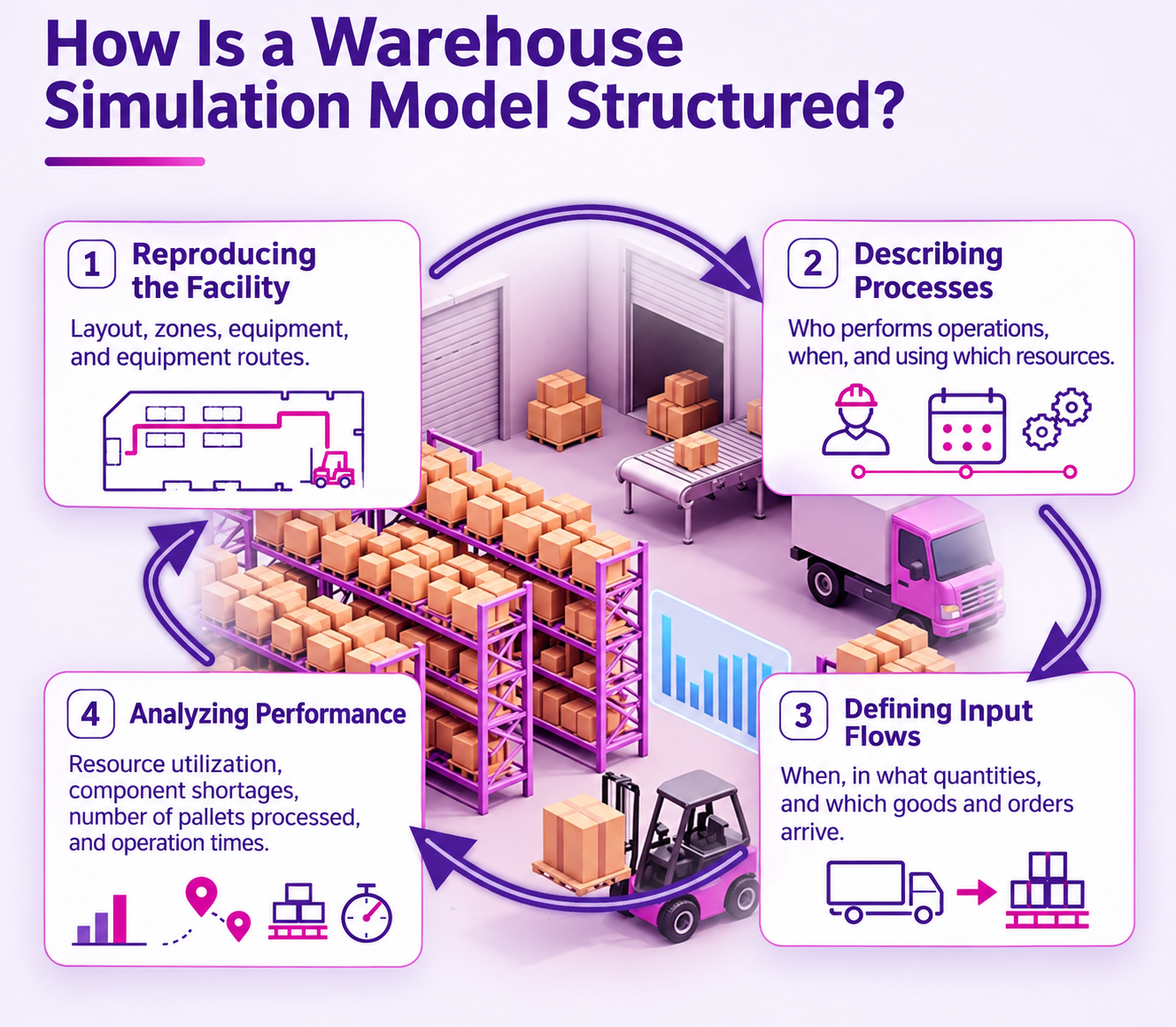
Warehouse operations are a set of interconnected flows: trucks arrive on schedule, orders are picked in waves, forklift drivers replenish the picking zone, finished pallets await shipping in temporary storage areas, and inventory counts and returns processing run in parallel. All resources are interconnected: the number of pickers determines the pace of wave picking, the number of forklifts determines the speed of replenishment and pallet removal, and the capacity of temporary storage areas limits warehouse throughput. Excess staff increases costs, while insufficient staff leads to missed picking deadlines and shipping delays.
Challenge
The client formulated two key objectives for the future tool. The first is regular assessment of current and required staffing levels: pickers, forklift drivers, and loaders. The second is periodic assessment of warehouse throughput, the impact of parameter changes, and bottlenecks in core processes: order picking, receiving, shipping, putaway and replenishment, and returns area operations.
The tool was subject to a set of requirements:
- accurate reproduction of the warehouse topology based on the client's layouts: locations of storage zones, docks, charging stations, and racks;
- implementation of real warehouse logistics business processes and warehouse management system (WMS) logic;
- calculation of key metrics: required headcount by role, travel distances and task execution times, plan vs. actual, throughput, zone utilization by hour, and gate load.
Solution
The project was delivered sequentially in four stages:
- At the analysis and data preparation stage, a pre-project assessment was conducted: description of warehouse processes, extraction and validation of data from the WMS and vehicle arrival registration systems.
- Next, a digital twin was developed — the AS-IS warehouse model. The second stage also included visualization, report development, and comparison of model runs with actual shifts.
- The following stage developed and tested a staffing calculation model on historical data.
- The final stage comprised documentation, user training, and handover of the system to operations.
AS-IS Model — a Virtual Digital Twin of the Warehouse
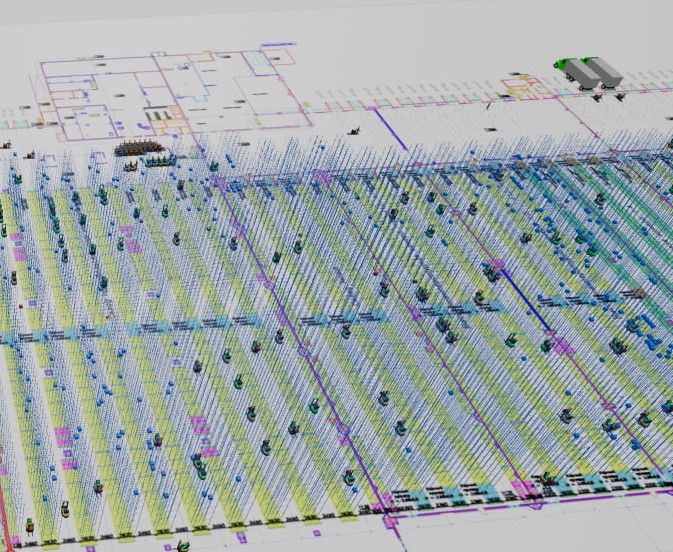
The AS-IS model reproduces actual warehouse operations based on the "digital footprint" automatically extracted from the WMS. A set of .CSV files — receiving, replenishment, picking, shipping, vehicle registration, inventory — contain data on every operation: who moved goods, when, and from which cell to which cell. The facility topology — storage zones, receiving and shipping docks, the ramp, charging stations, racks with cells — was transferred into the model in exact accordance with the client's layouts.
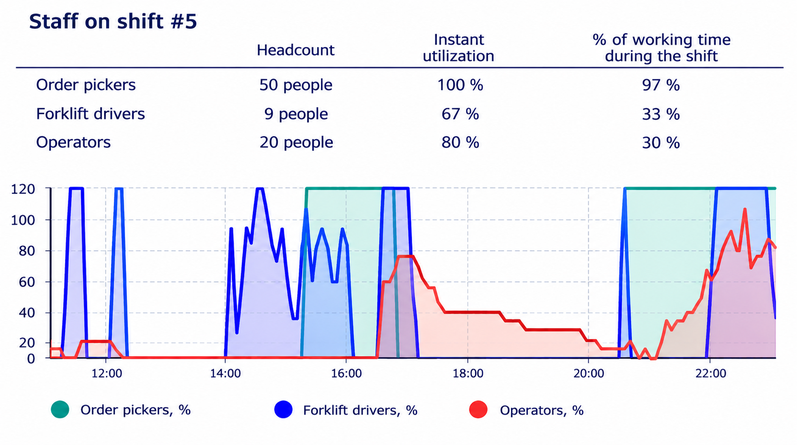
Run results are displayed on four screens: "Overview" with animation and key counters, "Statistics" with period metrics, "Utilization" of personnel by resource type, and the operations "Log". The model calculates the average truck assembly time, the number of trucks with missed assembly deadlines, productivity and labor costs per pallet and per truck, and the utilization of each personnel type. Comparison of runs with actual shifts confirmed the model's adequacy. With such a digital twin, the client can at any time review what happened at the warehouse and what caused a particular deviation in metrics. At the next stage, this model was used as a reference for calibrating the resource planning model.
Resource Planning Model Based on Demand Forecast
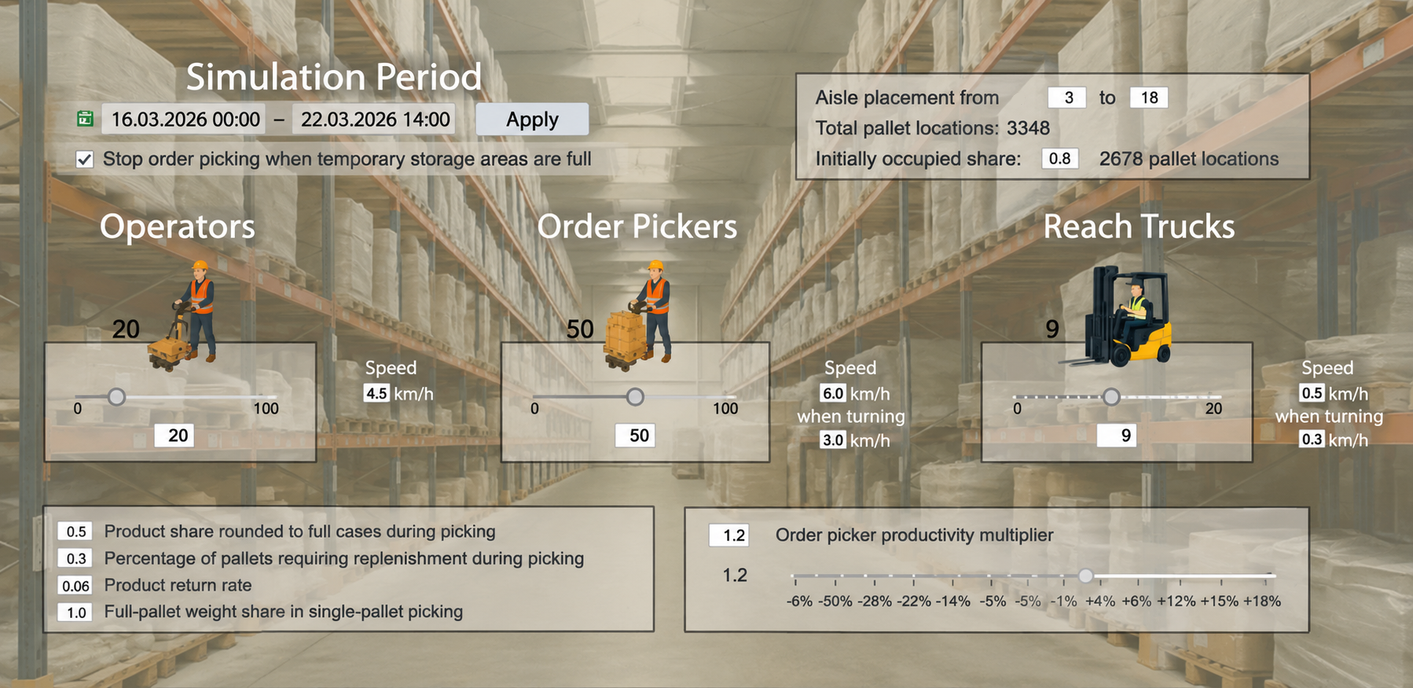
The planning model answers the question: how many resources are needed. Instead of operations history, it loads a shipping forecast by SKU and delivery point, product master data with weight and dimension characteristics, and picking algorithms from the WMS, after which it independently generates receiving, picking, replenishment, and shipping tasks. The user varies the number of operators, pickers, and forklift drivers, as well as process parameters: picker productivity, initial product placement and pallet position occupancy, the share of picks requiring replenishment, the returns percentage, and rules for shipping goods as full pallets.
A run for a day or a week answers the central planning question: what is the minimum staffing and equipment level at which the warehouse can handle the forecast cargo flow without missing planned deadlines.
Results
The client received a tool for planning calculations and warehouse analysis that enables:
- determining the minimum required number of pickers, forklift drivers, operators, and warehouse equipment against the demand forecast — with control over compliance with planned picking deadlines;
- assessing throughput and bottlenecks — hourly gate load, pallet position shortages, temporary storage area overload, routes with the longest travel distances — before implementing changes at the real facility;
- comparing plan vs. actual options — the planning model and the AS-IS model.
As part of the project, a series of business-critical experiments was conducted jointly with business users, documentation was prepared, and employee training was delivered.
Digital models have turned the warehouse into a manageable decision-making environment: any change — from adjusting shift staffing to reconfiguring racks and implementing automation systems — is first tested on the model and only then transferred to the real facility.